

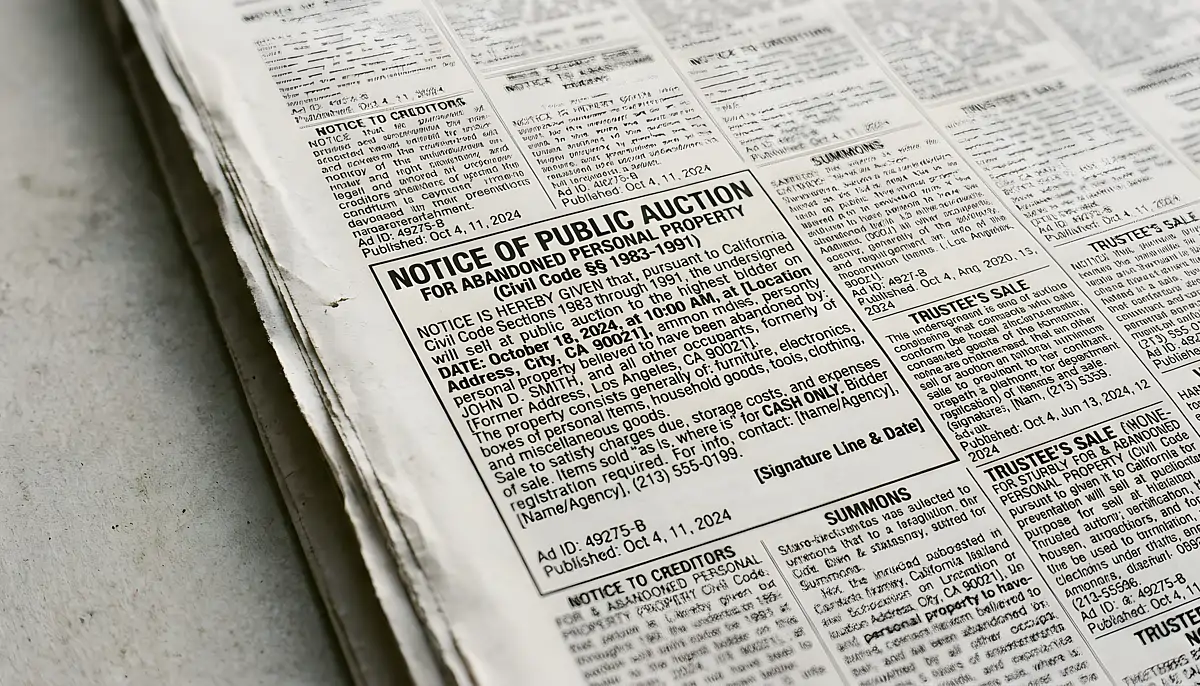
Abandoned Property Publication Requirements
Publication is required in situations where abandoned property must be sold rather than discarded. It marks the point where the process transitions from internal compliance steps to a public-facing sale.
Under California Civil Code §1988, when property exceeds the statutory threshold, it cannot be disposed of directly and must be sold at a public sale. That sale requires advance public notice, which is accomplished through publication. Without proper publication, the validity of the sale itself may be questioned.
When Publication Is Required
Publication applies once the process has moved beyond notice and the property is no longer eligible for direct disposal. At that stage, the focus shifts from holding the property to preparing it for sale in a structured and compliant manner.
This point is reached after the reclaim period has expired and the property has not been recovered. From there, publication becomes a required step that must be completed before the auction can proceed.
At that stage, the process shifts from holding and notice to sale preparation, and publication becomes a required step before the auction can proceed.
A complete explanation of how value determines when a sale is required appears in Abandoned Property Value Thresholds.
What Publication Accomplishes
Publication provides formal public notice that the property will be sold and establishes a record that the sale was announced in advance. This step ensures that the process is not conducted privately or without visibility to potential interested parties.
It also creates an opportunity for individuals with a possible interest in the property to come forward before the sale occurs. In addition, it supports the overall defensibility of the process by demonstrating that the sale was conducted transparently and in accordance with statutory requirements.
What Must Be Included In Publication
Publication requirements generally call for clear and accurate information about the upcoming sale. This typically includes a description of the property, the location of the sale, and the date and time at which it will occur.
The level of detail is important, as the notice must be sufficient to inform interested parties of what is being sold and when. Incomplete or overly vague descriptions can create uncertainty, particularly if questions arise after the sale has been completed.
Timing And Frequency Of Publication
Publication must follow specific timing rules that directly affect when the sale can take place. It is not a one-time announcement, but a structured requirement tied to statutory notice periods.
Under California Government Code §6066, publication is generally required once a week for two consecutive weeks, with defined timing requirements governing when the final publication must occur relative to the sale date. These requirements establish the earliest point at which the auction can be conducted.
A complete explanation of how publication fits into the overall sequence appears in Abandoned Property Process Timeline.
Common Issues With Publication
Most issues with publication arise from errors in timing, content, or execution rather than a failure to publish altogether. These may include scheduling the sale before publication requirements have been fully satisfied or publishing incomplete or inaccurate information.
Other problems can include using an improper publication medium or failing to retain proof that publication occurred. These issues can create complications if the validity of the sale is later questioned.
Where Publication Fits In The Process
Publication occurs after notice of reclaim rights has been completed and after it has been determined that the property must be sold. It serves as the bridge between compliance requirements and the actual execution of the sale.
Once publication has been properly completed, the process can move forward to auction with a defined timeline and structure. A complete explanation of reclaim notice appears in Notice Of Right To Reclaim, and the sale process itself is addressed in When Abandoned Property Must Be Sold At Auction.
Coordinating Publication With Auction Scheduling
Publication should be treated as an integrated part of the sale process rather than a separate administrative step. How and when notice is published affects not only compliance, but also how efficiently the auction can be scheduled and completed.
Coordinating publication timing with auction planning, confirming accuracy of sale details, and maintaining clear documentation all contribute to whether the process can proceed without delay or challenge.
Where publication timing, compliance, and auction coordination need to be handled carefully, many property owners rely on experienced professionals to manage the process from start to finish. A complete overview of how this is handled in practice appears in Abandoned Property Auctioneer Services.
Other States Considerations
In Nevada, publication requirements for abandoned property sales are addressed within Nevada Revised Statutes §118A.460, although the structure and timing differ from California's framework. The emphasis remains on providing notice before disposition, but the method and requirements vary.
In Arizona, Arizona Revised Statutes §33-1370 governs abandoned property handling and may include notice or publication-related requirements depending on the disposition method.
Because publication requirements vary by jurisdiction, the timing and format of notice must be reviewed carefully.
Relevant Statutory Framework
- California Civil Code §1988
- California Government Code §6066
- Nevada Revised Statutes §118A.460
- Arizona Revised Statutes §33-1370
Disclaimer: The information provided on this page is for general informational purposes only and does not constitute legal advice. Laws governing abandoned personal property and auction requirements vary by jurisdiction and specific circumstances. Property owners and managers should consult qualified legal counsel before taking action.