

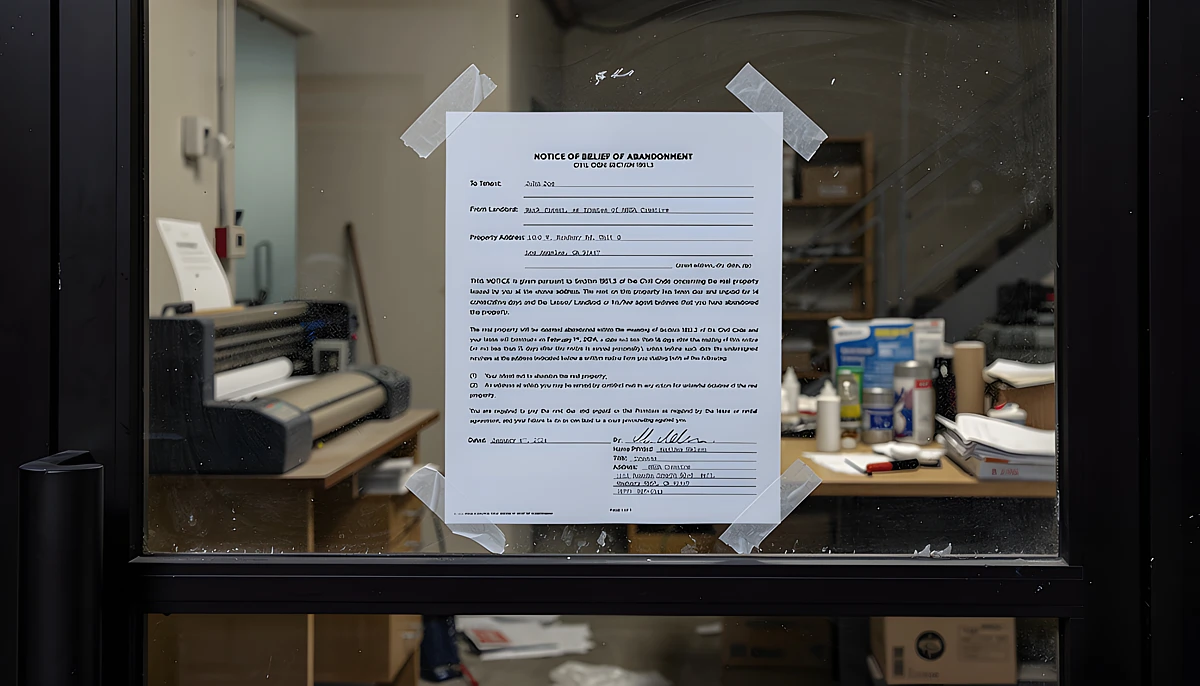
Abandoned Property Notice Of Belief Of Abandonment
A Notice of Belief of Abandonment is used when a tenant appears to have vacated but has not formally surrendered possession, and personal property remains behind.
Property cannot be treated as abandoned based on appearance alone under California Civil Code §§1983-1991. Where there is uncertainty about whether the tenant intends to return, this notice provides a structured way to establish that determination before moving forward.
It is not a disposal notice. It is the step that determines whether the abandoned property process can begin.
When This Notice Is Required
This notice is typically used where the tenancy has not ended through formal eviction and possession has not been clearly restored.
Common situations include tenants who vacate without notice, leave property behind, and stop communicating, or where access has been regained but the circumstances surrounding departure are unclear.
In these cases, the Notice of Belief of Abandonment creates a defined response period during which the tenant may confirm whether they intend to reclaim the property. If no response is received within that period, the property may then be treated as abandoned under the statutory framework.
What The Notice Accomplishes
The Notice of Belief of Abandonment serves two functions.
First, it provides the former tenant with a clear opportunity to respond before the property is treated as abandoned. This helps ensure that property is not incorrectly classified based on incomplete information.
Second, it establishes a defensible starting point for the process. Once the notice has been properly served and the response period has expired, the property may move into the next stage, where notice of reclaim rights and other requirements apply.
A complete explanation of how this transition occurs appears in Abandoned Property Process Timeline.
What Happens If The Tenant Responds
If the tenant responds within the notice period and indicates an intent to reclaim the property, the abandoned property process does not proceed as if the property were abandoned.
Instead, the situation must be addressed based on the tenant's response, which may involve coordinating retrieval, addressing access issues, or resolving any outstanding obligations tied to the tenancy.
The key point is that the notice prevents premature classification of the property and allows the tenant to clarify their position before further action is taken.
What Happens If The Tenant Does Not Respond
If no response is received within the defined period, the property may be treated as abandoned for purposes of the statutory process.
At that point, the process typically moves forward to notice of reclaim rights, which establishes the timeframe for the tenant to recover belongings before disposition becomes available. A complete explanation of that step appears in Notice Of Right To Reclaim.
Common Mistakes When Using This Notice
One of the most common mistakes is using this notice in situations where it is not appropriate, particularly where possession has already been restored through eviction. In those cases, the process typically moves directly to a Notice of Right to Reclaim rather than a belief of abandonment notice.
Another issue is treating the notice as a formality rather than a legal trigger. Errors in delivery, timing, or content can affect whether the property can be treated as abandoned at all.
There is also a tendency to assume that a lack of response automatically resolves all issues. While non-response allows the process to move forward, it does not eliminate the need to follow the remaining statutory steps.
Establishing A Clear Starting Point
The Notice of Belief of Abandonment is not about disposing of property. It is about establishing whether the process can begin.
When used correctly, it creates a clear and defensible starting point that allows the remainder of the statutory framework to be applied with confidence. When used incorrectly, it can introduce uncertainty at the very beginning of the process.
Where the facts surrounding abandonment are unclear, taking the time to handle this step correctly is often the difference between a smooth process and one that becomes difficult to defend later.
Where notice timing, delivery, or documentation needs to be handled carefully, many property owners rely on experienced professionals to coordinate the process from the outset. A complete overview of how this is handled in practice appears in Abandoned Property Auctioneer Services.
Other States Considerations
In Nevada, abandonment is addressed within the broader landlord-tenant framework under Nevada Revised Statutes §118A.460. While similar notice concepts exist, the process does not rely on a standalone “Notice of Belief of Abandonment” in the same structured form used in California.
In Arizona, Arizona Revised Statutes §33-1370 governs the handling of tenant property after tenancy termination. As in Nevada, the framework integrates abandonment into the overall process rather than relying on a separate initiating notice.
Because of these differences, the role and structure of this notice are more specific to California's statutory approach.
Relevant Statutory Framework
- California Civil Code §§1983-1991
- Nevada Revised Statutes §118A.460
- Arizona Revised Statutes §33-1370
Disclaimer: The information provided on this page is for general informational purposes only and does not constitute legal advice. Laws governing abandoned personal property and auction requirements vary by jurisdiction and specific circumstances. Property owners and managers should consult qualified legal counsel before taking action.